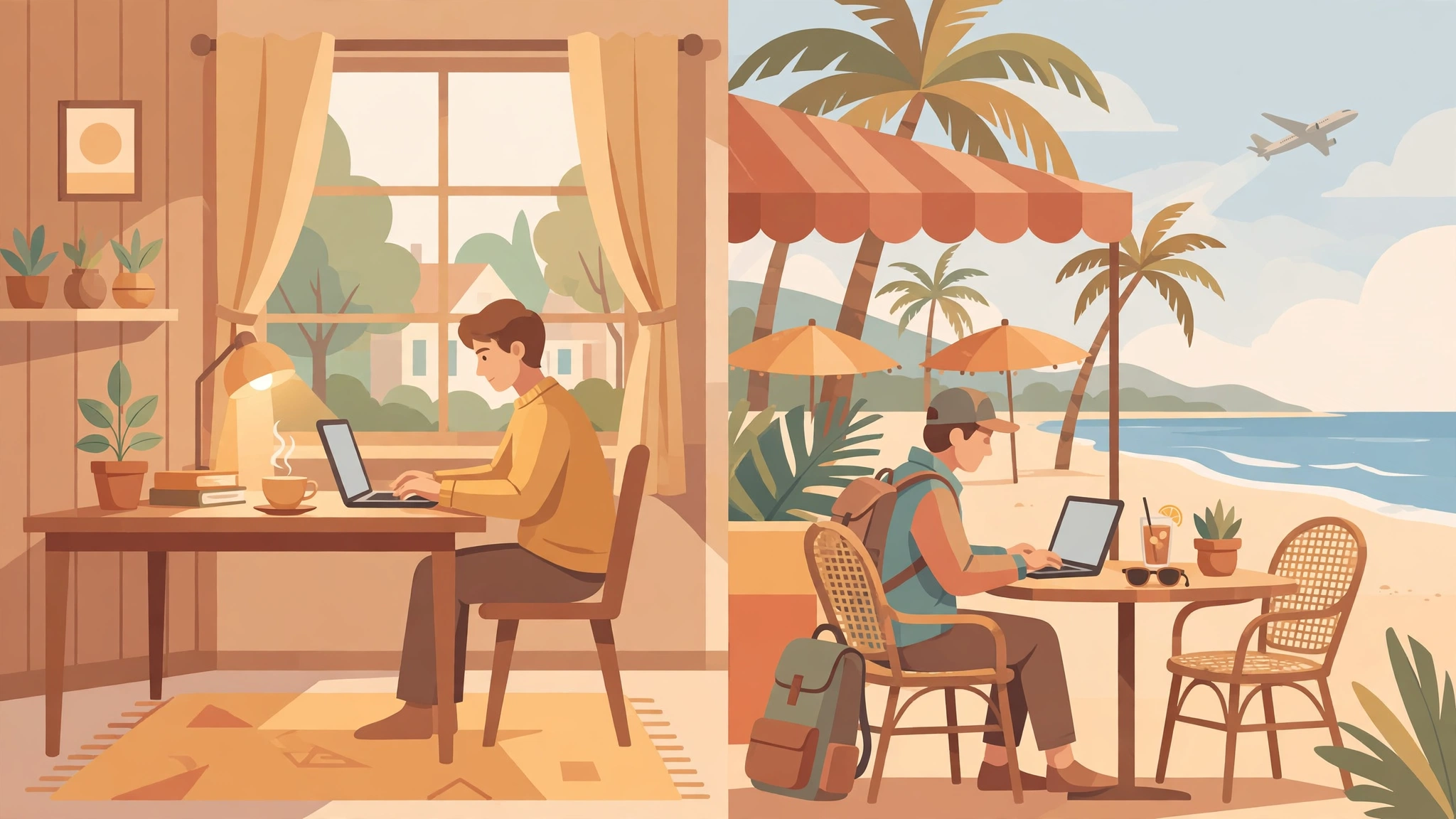

A remote worker is someone whose job is done away from a traditional office, usually from one home base, while a digital nomad is someone who uses remote work to keep moving — changing cities or countries regularly while earning online. The difference between a digital nomad and a remote worker is not the job itself; it is whether location is fixed or constantly changing.
That single distinction changes almost everything else: taxes, visas, employer rules, internet reliability, and even how you build a social life. Two people can hold the exact same job title and live completely different working lives depending on which side of that line they sit on.
What exactly is a remote worker?
A remote worker is an employee or freelancer whose work happens outside a central office. Most remote workers still live in one place. They have a home address, a regular desk (or a favorite corner of the kitchen table), and a routine built around one time zone. Their employer knows where they are, and their tax situation is usually straightforward: they pay tax where they live.
Remote work is an arrangement. It describes how you work, not where you travel. You can be fully remote for a decade and never leave your hometown — and plenty of people do exactly that, happily.
What exactly is a digital nomad?
A digital nomad is a remote worker who has made mobility the point. Instead of one home base, nomads move — from Lisbon to Chiang Mai to Mexico City, or simply from one rented apartment to the next every few months. Their “office” is wherever the Wi-Fi is good enough that day.
Nomadism is a lifestyle built on top of remote work. Every digital nomad is a remote worker, but very few remote workers are digital nomads. That one-way relationship is the source of most of the confusion between the two terms.
Digital nomad vs remote worker: what are the practical differences?
Where do you actually live?
A remote worker has a lease, a local doctor, and probably a favorite coffee shop where the staff know their order. A digital nomad has a booking confirmation, a short-term rental, and a mental list of which coworking spaces in town have backup generators. Stability versus novelty is the core trade-off, and it is worth being honest with yourself about which one you actually enjoy. Plenty of people love the idea of nomad life and hate the reality of repacking every six weeks.
What about taxes and visas?
This is where the difference stops being romantic and starts being paperwork. A remote worker typically files taxes in one country and deals with one set of rules. A digital nomad may trigger tax residency in a new country after 183 days, owe obligations in two places at once, or need a specific digital nomad visa — which now exists in dozens of countries, each with its own income threshold and conditions.
Working from another country on a tourist visa, which many early nomads did quietly, can be illegal. If your employer finds out you are working from a country where they have no legal entity, they may have a compliance problem too — which is why many companies restrict remote workers to approved locations even while calling the job “remote.”
Does your employer care?
Usually, yes — a lot. Most remote jobs are remote within limits: your country, your state, or a set list of approved regions. A company hiring a remote worker in Texas is not automatically agreeing to that worker relocating to Bali. Before you turn a remote job into a nomad life, check the policy. Some employers allow it with approval; some allow it only for limited stretches; some will end the arrangement if you move without telling them. This conversation should happen before you book the flight, not after.
What does it do to your daily work?
Remote workers build deep routines: same desk, same hours, same team overlap. Digital nomads trade routine for flexibility and pay for it in friction — hunting for reliable internet, adjusting to new time zones every few weeks, and rebuilding a social circle from scratch. Both can be productive, but they demand different skills. The nomad needs adaptability and logistics; the home-based remote worker needs discipline and boundary-setting.
Which one are you actually choosing? A quick test
Answer honestly:
- When you picture your ideal workday a year from now, is the background the same room or a different city?
- Would a surprise two-week delay — a visa hold-up, a broken laptop abroad — feel like an adventure or a crisis?
- Do you want roots (neighbors, a gym, a regular routine) or do you get restless after a few months in one place?
Mostly “same room” and “roots”: you want remote work. Mostly “different city” and “restless”: nomad life may suit you. Mixed answers are normal — and they point to the middle path below.
The middle path most people actually take
Here is the option the internet rarely talks about: the slowmad, or part-time nomad. You keep one home base and travel in longer stretches — a month in another city each quarter, or summers elsewhere while keeping your lease. You get most of the variety with a fraction of the paperwork, and your employer’s compliance team can usually approve a defined stint far more easily than permanent wandering.
I tested this myself before committing to anything bigger: one month working from a different city, with my normal hours and my normal workload, just a different backdrop. That single month taught me more about my tolerance for nomad friction — the internet outages, the time-zone math, the loneliness of weekday evenings in a new place — than a year of reading nomad blogs. Try the small version before you sell the furniture.
Which path pays better?
Neither, inherently. Pay follows the job and the market, not the lifestyle. But the costs differ sharply: a nomad’s travel, short-term rentals, travel insurance, and coworking memberships can quietly eat the salary advantage of a remote job, while a home-based remote worker’s costs are mostly fixed and predictable. Freelancers have more freedom to go nomad because they answer to clients, not an employer’s location policy — but they also carry the tax and insurance burden alone. Run the numbers for your own situation before assuming either path is cheaper.
Frequently Asked Questions
Can a remote worker become a digital nomad without changing jobs?
Sometimes. It depends on your employer’s location policy, not your job title. Ask for written approval for the specific countries and timeframes you have in mind, and sort out tax and visa requirements before you move — not after.
Is digital nomad life cheaper than working remotely from home?
Not automatically. Short-term rentals, flights, travel insurance, and coworking passes add up, and popular nomad hubs have rising rents. Some nomads do save money by geo-arbitraging to lower-cost countries, but that only works if your income stays at home-country levels and your costs genuinely drop.
Do digital nomads pay tax in every country they visit?
Usually not in every country, but the rules depend on how long you stay and where your income comes from. Many countries treat stays over 183 days as tax residency. Digital nomad visas often come with their own tax treatment. This is genuinely a “talk to a tax professional” situation — the penalties for guessing wrong are real.
Is it better to be a digital nomad or a remote worker?
Neither is better in the abstract. Remote work suits people who want stability, routine, and deep local roots. Nomad life suits people who genuinely enjoy constant change and can tolerate its logistics. The honest test is a trial month, not a personality quiz.
The bottom line
The digital nomad vs remote worker difference comes down to one question: is your location fixed or is it the whole point? Remote work is the arrangement that makes both lives possible. Nomad life is what happens when you build constant movement on top of it. Choose the version that fits your tolerance for paperwork, change, and uncertainty — and if you are unsure, try the middle path first. The Wi-Fi in a new city will still be there next quarter.