
The Pomodoro technique works for remote work when you stretch it: use 50-minute focus blocks with 10-minute breaks for deep work, keep the classic 25-minute sprint only for shallow admin, and protect each block with a visible “do not disturb” signal. The timer is not the point — the point is a start and a finish your brain can trust.
Why Does the Classic 25-Minute Pomodoro Fail Remote Workers?
The original Pomodoro technique, invented by Francesco Cirillo in the 1980s, is simple: work 25 minutes, rest 5, repeat four times, then take a longer break. It works beautifully for students cramming and for anyone facing a task they keep avoiding. But remote workers who try it as written usually quit within a week, and the reason is not laziness — it is the shape of real remote work.
Most remote work is not 25 minutes long. Writing a report takes ninety minutes. Debugging a problem takes an hour. When the timer rings at 25 minutes, you are in the middle of a thought, and the break that is supposed to refresh you instead breaks the thread. You spend the first ten minutes of the next block rebuilding what you just lost.
There is a second problem. At home, the 25-minute rhythm creates too many seams — and every seam is an opening for a distraction. The timer rings, you stand up for your five-minute break, and there is the laundry, the phone, the fridge. Short breaks are too short to be useful and too frequent to be safe. A remote worker does not need more chances to drift; they need fewer, stronger containers for attention.
It takes roughly 20 minutes to reach full concentration on a complex task, so a 25-minute block gives you about five minutes of peak focus before the bell rings — a terrible return on the hardest part of the work, the getting started. The technique is not wrong; the interval is wrong for the job.
How Should You Adapt the Pomodoro Technique for Remote Work?
The fix is to match the interval to the task. Here is the version that actually sticks for remote workers:
Deep work gets 50 minutes on, 10 minutes off. Fifty minutes is long enough to reach full concentration and do real work in it, and short enough that the end is always in sight. After two 50/10 cycles, take a proper 25- to 30-minute break — lunch, a walk, something away from the screen. Three of these pairs make a solid workday: roughly four and a half hours of genuinely deep work.
Shallow work keeps the classic 25/5. Email, expense reports, scheduling, inbox triage — these are exactly the tasks the original 25-minute sprint was built for. They are small, defined, and slightly boring, which is why the timer helps: it turns a dull task into a race you can win. Batch your shallow tasks into one or two 25-minute blocks a day and keep them out of your deep-work hours.
One task per block, written down before the timer starts. The single most common failure is starting a timer with a vague intention like “work on the project.” A block needs a sentence: “Finish the first draft of the onboarding email” or “Fix the checkout bug on the pricing page.” Write it on a sticky note before you press start. If you cannot state the task in one sentence, the task is too big — shrink it until you can.
A visible “in a Pomodoro” signal. Remote work’s unique problem is that the people around you cannot see that you are busy. A closed door helps; a small sign helps more. I use a cheap desk flag — red side up means do not interrupt unless the house is on fire. My family learned the rule in about a week.
What Does a Pomodoro Remote Work Day Actually Look Like?
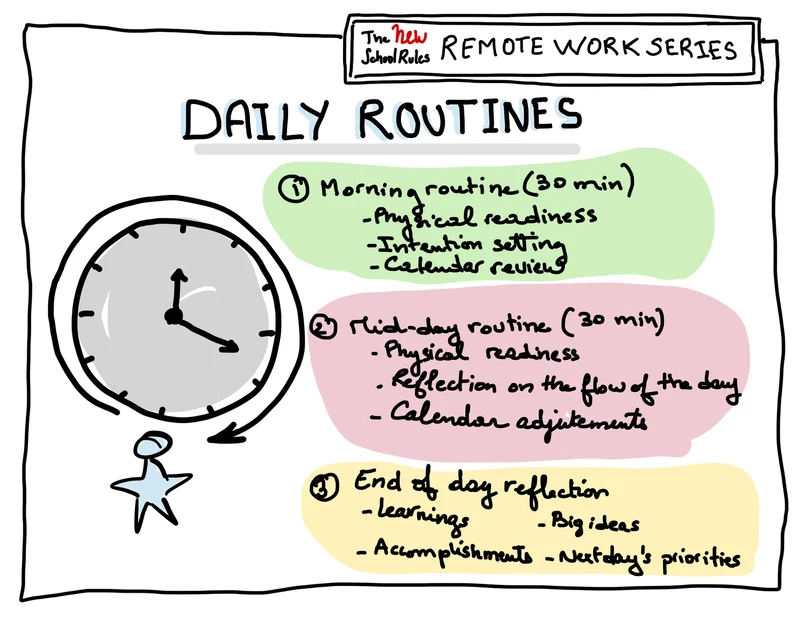
Theory is cheap, so here is a real day built on this system — the one I used while writing this article:
- 9:00 – 9:50: Deep block 1 — draft the article, phone in another room.
- 9:50 – 10:00: Break — stretch, water, look out the window. No phone.
- 10:00 – 10:50: Deep block 2 — finish the draft and outline the FAQ.
- 10:50 – 11:20: Long break — walk around the block, coffee.
- 11:20 – 11:45: Shallow block — answer emails and messages in one 25-minute sprint.
- 11:45 – 12:35: Deep block 3 — edit the draft, add examples.
- 12:35 – 1:30: Lunch, away from the desk.
- 1:30 – 2:20: Deep block 4 — the second-hardest task of the day.
- 2:20 – 2:30: Break.
- 2:30 – 2:55: Shallow block — plan tomorrow’s top three tasks, close the tabs.
That is four deep blocks and two shallow ones — about five hours of focused work, finished by 3 p.m. The day feels shorter and produces more, because the hours in it are actually worked.
Try this mini-test before you commit: run the system for one morning only, with just two deep blocks. Track how many words, tickets, or tasks you finish versus a normal morning. Most people who try it never go back — not because the timer is magic, but because for the first time they can see exactly how much they did, and when.
How Do You Handle Interruptions Without Breaking the Timer?
Home is full of interruptions: the delivery driver, a child with a question, a message that “just takes a second.” The classic Pomodoro rule says an interrupted Pomodoro is void — you abandon it and start again. That rule is too harsh for home life, and it is why people quit. Use this instead:
External interruptions: pause, don’t void. If someone needs you, stop the timer, deal with it, and restart the timer when you sit back down. You lose the minutes, not the block. A two-minute pause costs two minutes; treating the block as ruined costs fifty.
Internal interruptions: park them on paper. The thought that pops up mid-block — “I need to email Sarah,” “did I pay the electricity bill?” — feels urgent and is not. Keep a small notepad beside you and write it down in five seconds, then return to the task. The note stops the thought from looping, and it gives you a list to work through in your next shallow block. After a week of this, the interruptions themselves get quieter, because your brain learns that parked thoughts actually get handled.
Planned interruptions: schedule them between blocks. If you know the washing machine finishes at 11, or the kids come home at 3, plan your blocks around those times instead of fighting them. A Pomodoro system that ignores your real life will lose to your real life every time.
Which Timer Should You Use?
The simplest one you already have. A kitchen timer works. Your phone’s timer works, as long as the phone is face-down and out of reach during the block. Dedicated apps like Forest or Focus Keeper add history and streaks — but the app is not the system. The system is one task, one timer, one visible signal, repeated.
Frequently Asked Questions
How long should a Pomodoro be for remote work?
Fifty minutes of focus with a ten-minute break works best for deep remote work — long enough to reach full concentration and do real work in it. Keep the classic 25-minute sprint for shallow tasks like email and admin, where the short deadline helps.
Does the Pomodoro technique actually help you focus working from home?
Yes, when it is adapted to remote work. The timer gives your brain a clear start and finish, which is exactly what a home office lacks. The key is matching the interval to the task — 50/10 for deep work, 25/5 for shallow work — and protecting each block with a visible do-not-disturb signal.
What do you do when a Pomodoro gets interrupted at home?
Pause the timer, deal with the interruption, and restart it when you sit back down. Only the minutes are lost, not the block. For thoughts that pop up mid-block, write them on a notepad in five seconds and handle them in your next shallow block.
How many Pomodoros should you do in a day?
Three to four deep 50-minute blocks is a strong day — about four hours of real deep work. Add one or two 25-minute shallow blocks for email and admin. More blocks are not better; finished blocks are.