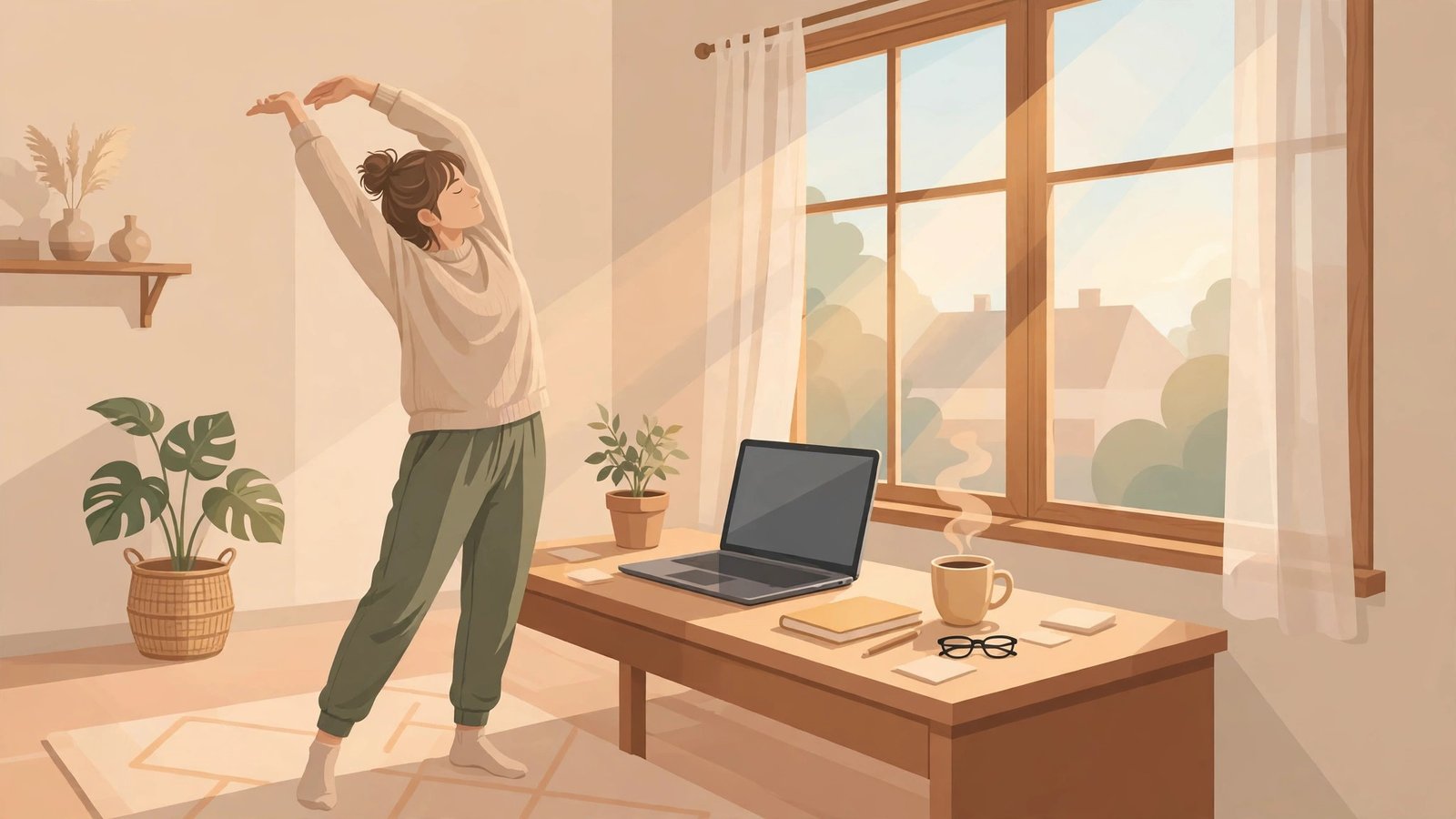

A work from home morning routine that actually works is a 30-minute startup ritual: get dressed like you’re going somewhere, write down your top three tasks, set up your desk, and start with the hardest task first. It replaces the commute’s psychological transition — the missing piece that makes most remote mornings drift.
The strangest thing about my first months of remote work was the mornings. I would wake up, make coffee, open the laptop in my pyjamas, and then somehow it would be 10:30 and I had answered three emails and done nothing that mattered. I wasn’t lazy. I was missing a transition. A commute is annoying, but it does real psychological work: it tells your brain that home time is over and work time has begun. Without it, the day just… bleeds in.
Most work from home morning routine advice misses this completely. It gives you a list of wholesome habits — meditate, journal, drink lemon water — and never explains why the morning still feels like wading through fog. The routine that actually fixed my mornings is not about wellness. It is about building a clear, repeatable switch from “person at home” to “person at work,” in about thirty minutes.
Why do remote mornings drift when office mornings don’t?
In an office job, the morning has a built-in structure: alarm, shower, commute, desk, first task. Each step narrows your options until you are sitting at a desk with one thing to do. Working from home collapses all of that into one room and one decision — “open the laptop” — which your brain files under the same category as checking the news or scrolling social media, because it happens in the same place, in the same clothes, on the same device.
That is why willpower-based advice fails here. You cannot decide your way into focus when nothing around you has changed. The fix is a small sequence of physical actions that create the transition the commute used to provide.
What is the 30-minute startup ritual?
Here is the work from home morning routine I have used for two years, in a one-bedroom flat with no spare room. It takes about thirty minutes, and every step has a job to do.
| Minutes | Step | What it does |
|---|---|---|
| 0–5 | Get dressed like you are going somewhere | A physical boundary between home and work |
| 5–10 | Leave the flat, briefly | The fake commute — movement and a door threshold |
| 10–15 | Write down three tasks — on paper | Decide before the inbox gets a vote |
| 15–20 | Set up the desk | Clear yesterday’s clutter, open only what the first task needs, phone in another room |
| Next 50 minutes | Start with the hardest task | Your sharpest hour on real work — no email, no messages |
1. Get dressed like you are going somewhere (5 minutes). Not a suit — just real clothes, different from what you slept in. This is the single most powerful switch in the whole routine. Pyjamas tell your brain you are still in rest mode; changing clothes is a physical boundary between home and work. I keep a “work hoodie” that only gets worn during work hours. It sounds silly. It works anyway.
2. Leave the flat, briefly (5 minutes). Step outside — walk to the corner shop, get coffee, or just walk around the block. This is the fake commute, and it is the step most people skip and most need. Ten minutes of fresh air and movement separates “woke up” from “working” more effectively than any app. On bad-weather days, I do a lap of the building’s stairwell. The point is movement and a door threshold, not exercise.
3. Write down three tasks — on paper (5 minutes). Before opening the laptop, write your top three tasks for the day on a notepad. Not a to-do app, not a project board: paper, three lines. This forces a decision before the inbox gets a vote. If you open email first, your day becomes other people’s priorities. Three tasks is deliberately small — it is what a good day actually looks like, and finishing all three feels like a win instead of a dent in a list of twenty.
4. Set up the desk (5 minutes). Clear yesterday’s clutter, open the one document or tool your first task needs, close everything else. Put the phone in another room. This is the “opening the shop” moment — the desk is now a workplace, not a kitchen table with a laptop on it.
5. Start with the hardest task, for 50 minutes (the rest of the morning). No email, no messages, no “quick check” of anything. The first work block of the day is your sharpest hour; spending it on email is like using a new blade to open envelopes. Fifty minutes, then a real break.
What should you do the night before to make mornings work?
A morning routine that starts in the morning is already late. The night-before step takes two minutes and removes the morning’s hardest decision: what to work on first.
Before you shut down, write tomorrow’s first task on a sticky note and leave it on the keyboard. That is it. When you sit down in the morning, there is no “what should I do first?” moment — the moment where most drift happens, because it is exactly when the phone gets picked up “just for a second.” Decide tonight, execute in the morning.
I tested this against my old habit of deciding in the morning. On decide-in-the-morning days, my first real work started around 10:15 on average; on sticky-note days, it started by 9:20. Same person, same job, same flat. The only difference was when the decision was made.
How do you handle a morning routine when you share a small space?
If you share a flat, your routine has to be quiet and compact — no 5 AM blender smoothies, no hour of journaling at the kitchen table while everyone else sleeps. The ritual above is deliberately low-footprint: dressing, a short walk, a notepad, a tidy desk.
The one extra piece is a household signal. Agree with the people you live with that headphones on during your first work block means “I’m working,” and that you will be properly available at a set break time. Morning is when this matters most, because it is when other people are also getting ready and the “quick question” rate is highest. A short, visible start to your day protects the rest of it.
What if you are not a morning person?
Then do not build a routine that requires you to become one. The startup ritual is not about waking at dawn; it is about the sequence, whenever it happens. If your work starts at 10, run the ritual at 9:30. The research on chronotypes is clear that forcing an early start on a night owl costs more focus than it gains.
What you should not do is skip the ritual because you “work better later.” Later focus still needs a start, and without a transition, “later” slides to noon. Keep the sequence, shift the clock.
What does a bad remote morning actually cost?
More than it feels like. A drifted morning does not just lose an hour; it sets the day’s tempo. When the first task starts late and half-focused, everything after it inherits that looseness — the afternoon drags, the shutdown ritual gets skipped, and the evening feels like you never quite finished. A clean start compounds in the other direction: one finished hard task by 10:30 makes the rest of the day feel manageable.
That is the real test of a work from home morning routine. Not whether it looks good on paper, but whether it reliably produces a started day. If your current routine leaves you drifting past 10, it is not a routine — it is a habit of waiting. Replace it with a sequence that ends at a desk, with a task, and the rest of the day mostly sorts itself out.
Related reading: daily routine for remote workers, how to stay productive while working from home, work from home tips for beginners
Frequently Asked Questions
How long should a work from home morning routine take?
Thirty minutes is enough for most people: dress, a short walk, three tasks on paper, desk setup, then straight into the hardest task. Longer routines tend to collapse on busy days, which is exactly when you need the routine most. Keep it short enough to do on a bad morning.
Should you check email first thing in a work from home morning routine?
No. Email first hands your day’s priorities to other people and turns your sharpest hour into reactive work. Write your three tasks before opening the laptop, and check email only after your first focused work block — most “urgent” messages are still fine an hour later.
Do you need to wake up early for a good work from home morning routine?
No — the sequence matters more than the clock time. Run the same startup ritual at whatever time your workday starts. What matters is the transition from home mode to work mode, not the hour on the clock.
What is the single most important part of a remote morning routine?
Deciding your first task the night before. It removes the morning’s biggest drift point — the “what should I do first?” moment when the phone gets picked up and the morning unravels. Everything else in the routine supports that one decision.